
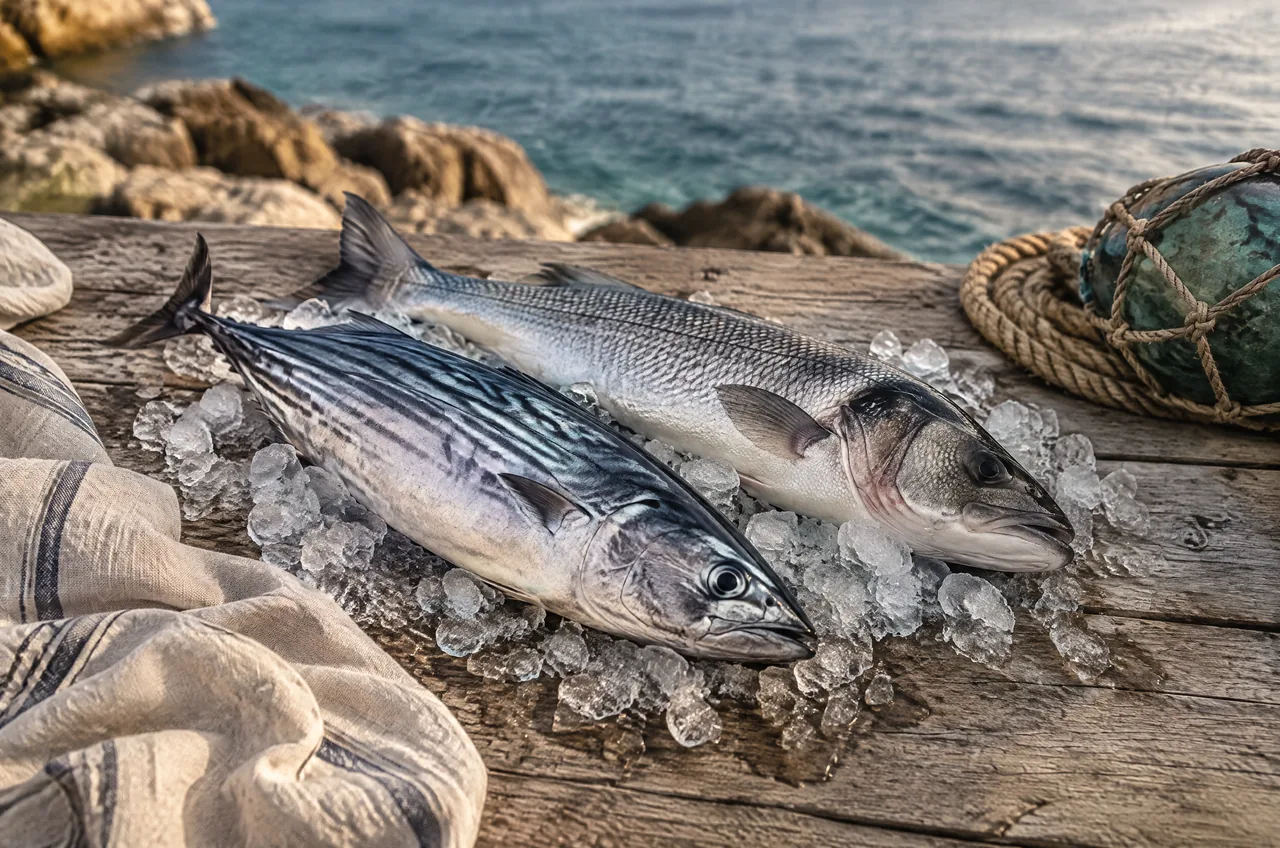
The difference between wild and farmed fish is how the fish lived and what it ate: wild fish is caught at sea, in a river or a lake, while farmed fish is raised in cages, tanks or ponds on controlled feed. According to the FAO, in 2022 aquaculture produced more aquatic animals than capture fisheries for the first time, 94.4 million tonnes against 92.3 million, which means more than half of the world's fish is now farmed. Neither one is "bad" and neither is automatically "better": the differences are in taste, texture, fat, price and season.
Below are the answers to the questions our guests ask most often: which one is healthier, how to tell them apart, why wild fish costs more and which Black Sea fish is almost always wild. The examples come from the Mr. Baba menu in Varna, with real 2026 prices.
What is the difference between wild and farmed fish?
Wild fish feeds itself on whatever it finds in the sea and moves freely, while farmed fish receives prepared feed and lives in a confined space. Every other difference follows from that. Wild fish swims more, so its flesh is usually firmer and leaner. Farmed fish moves less and eats on a schedule, so it is often fattier and milder in flavour.
The same fish, two lives
Many species exist in both versions. In Europe, salmon, sea bass and sea bream are overwhelmingly farmed, and their wild counterparts are rare and cost considerably more. The opposite is true of Black Sea species such as bonito, horse mackerel, sprat and turbot: they are caught at sea, because they are not farmed on any real scale.
Taste and texture
Wild fish has a stronger, more "marine" flavour that changes with the season and with what the fish has been eating. Farmed fish is more predictable: every piece tastes almost like the last. For a cook this means a different approach. Wild fish wants less time on the heat, while farmed fish can carry more sauce and seasoning.
Which is healthier, wild or farmed fish?
Wild and farmed fish are both healthy, but in different ways: wild fish is usually leaner, while farmed fish often contains more fat, including more omega-3 per portion. The most quoted comparison is a 2012 Norwegian study (Jensen et al., Nutrition Bulletin) of 20 farmed and 20 wild Atlantic salmon. The farmed salmon contained about 12% fat against about 6% in the wild fish, and more EPA and DHA per 100 grams.
The omega-3 caveat
The same study found that farmed salmon had roughly nine times more omega-6, because the feed contains vegetable oils. Since 2012, salmon feed has also used less and less fish oil, so today's omega-3 levels in farmed salmon are probably lower. The 2012 figures are a guide, not a rule.
What this means in practice
If you want lean protein, wild white fish such as turbot or sea-caught sea bass is an excellent choice. If you want more omega-3 per portion, oily fish helps most, whether wild or farmed: bonito, horse mackerel, mackerel, salmon. Black Sea bonito and horse mackerel are naturally oily, and they are wild.
How can I tell whether fish is wild or farmed?
In a shop, the answer is on the label: under Article 35 of Regulation (EU) No 1379/2013, all fresh fish sold to consumers must state the production method, "caught" or "farmed", and the area where it was caught or raised. The Black Sea has its own FAO code, subarea 37.4, and if you see it on the label, the fish was caught in our sea.
What the label says
| Label wording | What it means | Example |
|---|---|---|
| Caught at sea, FAO 37.4 | Wild fish from the Black Sea | Bonito, horse mackerel, turbot |
| Caught at sea, FAO 37.1-37.3 | Wild fish from the Mediterranean | Sole, octopus |
| Caught in freshwater | Wild river or lake fish | Carp, wels catfish |
| Farmed | Farmed fish, with the country where it was raised | Sea bream, sea bass, salmon, sturgeon |
And in a restaurant?
In a restaurant the labelling rule stops short of the plate: the supplier must give the restaurant this information, but for a dish on the menu the law only requires allergen information. So the simplest thing is to ask your waiter. A good restaurant knows where every fish in its kitchen comes from. For the signs of freshness, see our article on how to tell if fish is fresh.
Why is wild fish more expensive?
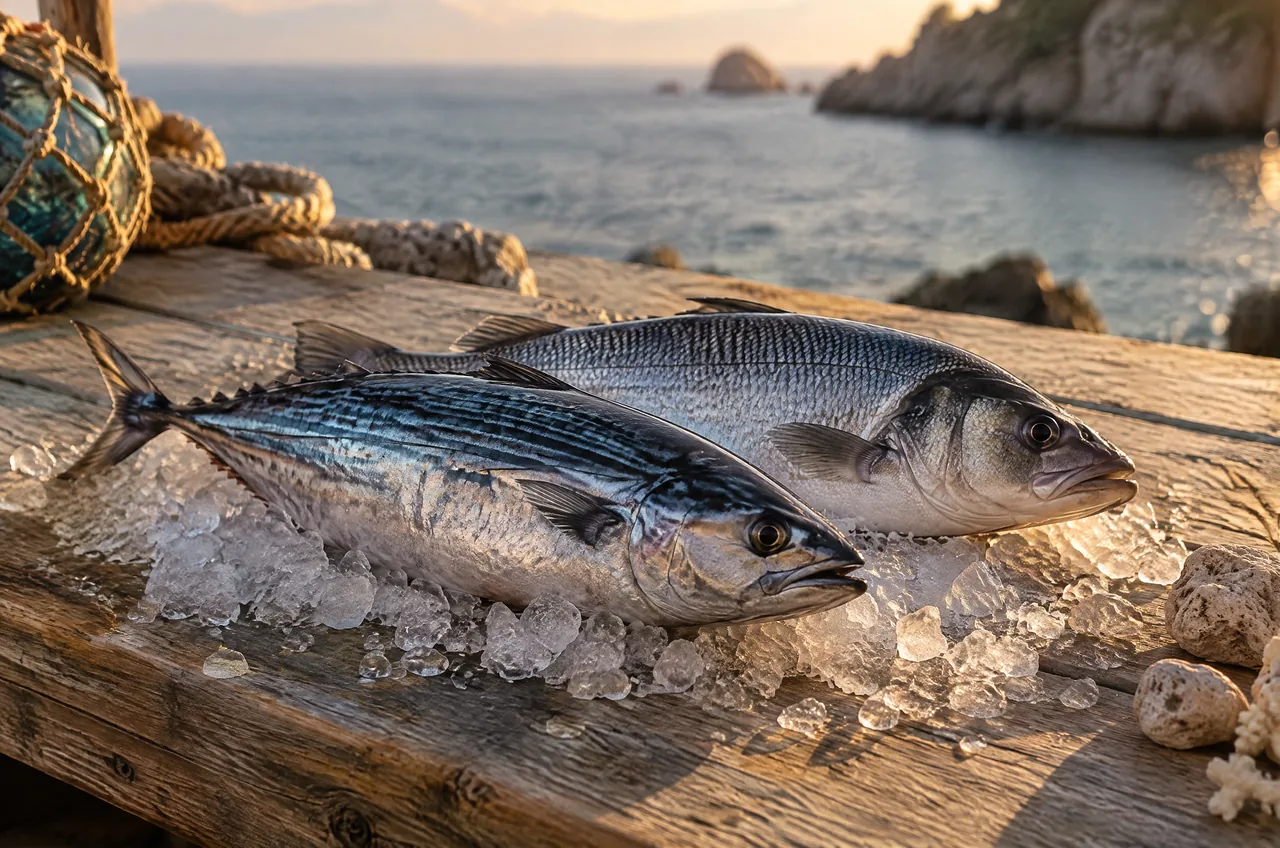
Wild fish costs more because the supply is limited by the sea, the season and quotas, while farmed fish is produced to plan all year round. Black Sea turbot is a good example: the European Union sets a quota for Bulgaria, which according to the Bulgarian News Agency (BTA, December 2024) is 82.5 tonnes a year, and fishing for it is closed from mid-April to mid-June for spawning.
The season drives the price
The price of wild fish moves with the weather and the season. Bonito is most plentiful and at its best in autumn, when the shoals pass along the coast near Varna, while on stormy winter days the boats stay in port and less fish reaches the market. Farmed fish has none of these swings. We have written about the seasons in detail in our article on Black Sea fish species.
Menu prices, 2026
On the Mr. Baba menu, turbot in garlic olive oil is €8.99 per 100 grams, bonito fillet with rosemary is €12.99 for 220 grams and horse mackerel is €9.99 for 250 grams. For comparison, barramundi fillet is €15.99 for 350 grams and the salmon and prawn skewer is €16.99. The price of a portion also depends on the side, but the price per gram shows how valuable wild white fish is.
Which Black Sea fish is always wild?
Bonito, horse mackerel, sprat, gobies, red mullet and Black Sea turbot are caught at sea, because they are not farmed on any real scale in Bulgaria. When you order one of them in a fish restaurant on the Bulgarian coast, you are almost certainly eating wild fish caught that same season. That is exactly why these species appear on menus and disappear again with the time of year.
Sturgeon is the opposite case
Sturgeon in Bulgaria comes from farms, because the wild fish is protected. According to the International Union for Conservation of Nature (2022), beluga, Russian sturgeon and stellate sturgeon are critically endangered, and since 1 January 2026 an indefinite ban on catching them has applied in the Bulgarian stretch of the Danube and in the Black Sea, according to Bulgaria's Ministry of Environment and Water. The grilled sturgeon on our menu, €15.29 for 250 grams, almost certainly comes from a farm, like all sturgeon on the Bulgarian market.
Barramundi and salmon
Barramundi is a fish of the Indian and Pacific Oceans, and in Europe it is sold from farms, according to the FAO species fact sheet. Atlantic salmon on the European market is likewise almost entirely farmed.
Is farmed fish worse?
Farmed fish is not worse, just different: good aquaculture produces clean, traceable fish of consistent quality, while poor aquaculture produces bland fish with excess fat. The difference lies in the individual farm, not in the word "farmed". In the European Union, fish farms are subject to veterinary control and the use of medicines is regulated.
When farmed is the better choice
Farmed fish makes sense when the wild fish is protected, as with sturgeon, when the species does not live in our sea, as with barramundi, or when you want the same fish all year round. Wild fish makes sense when it is in season and when you want the taste of a particular sea. A good kitchen uses both, honestly and according to the season.
From our kitchen
Mr. Baba is a galleon on the beach next to the Sea Station in Varna, and the kitchen on board follows one rule: the fish is in charge, not the cook. In practice this means that wild Black Sea fish goes on the menu when the sea provides it. In October that means bonito, which we roast as a fillet with rosemary, and horse mackerel, which we serve whole. Turbot is sold by weight, because every fish is different and the price should be fair to the piece on your plate.
The restaurant stays open out of season, when many fish restaurants along the coast close, and in winter the menu changes with the sea. That is when the species that do not depend on the weather play a bigger role: sturgeon, barramundi, salmon. Our mussels come in 700-gram portions, three ways, from €11.99. If you are not sure what to choose, ask about the fish of the day: your waiter will tell you where it comes from and how it is best prepared.
Frequently asked questions
Which is healthier, wild or farmed fish?
Both are healthy. Wild fish is usually leaner, while farmed fish often contains more fat and more omega-3 per portion, but also more omega-6. Oily fish such as bonito, horse mackerel and salmon brings the most benefit, whatever its origin.
How can I tell if fish in a shop is wild?
Check the label. Under Regulation (EU) No 1379/2013 it must say "caught" or "farmed" and give the area. FAO code 37.4 means the fish was caught in the Black Sea.
Is there wild sturgeon in the Black Sea?
There is, but catching it is banned. Since 1 January 2026 an indefinite ban on catching sturgeon has applied in the Black Sea and the Bulgarian stretch of the Danube, so the sturgeon in Bulgarian restaurants and shops comes from farms.
Why is bonito best in autumn?
In autumn, shoals of bonito migrate along the Bulgarian coast, and the fish has built up fat over the summer. That makes autumn the season when bonito is at its oiliest and tastiest, and easiest to find fresh.
Taste the difference at the table
The best way to taste the difference between wild and farmed fish is to order them side by side: bonito or turbot from the sea next to barramundi or sturgeon from a farm. Browse the menu, read more about bonito and horse mackerel and book a table on the galleon. Autumn is the best time of year for Black Sea fish.