
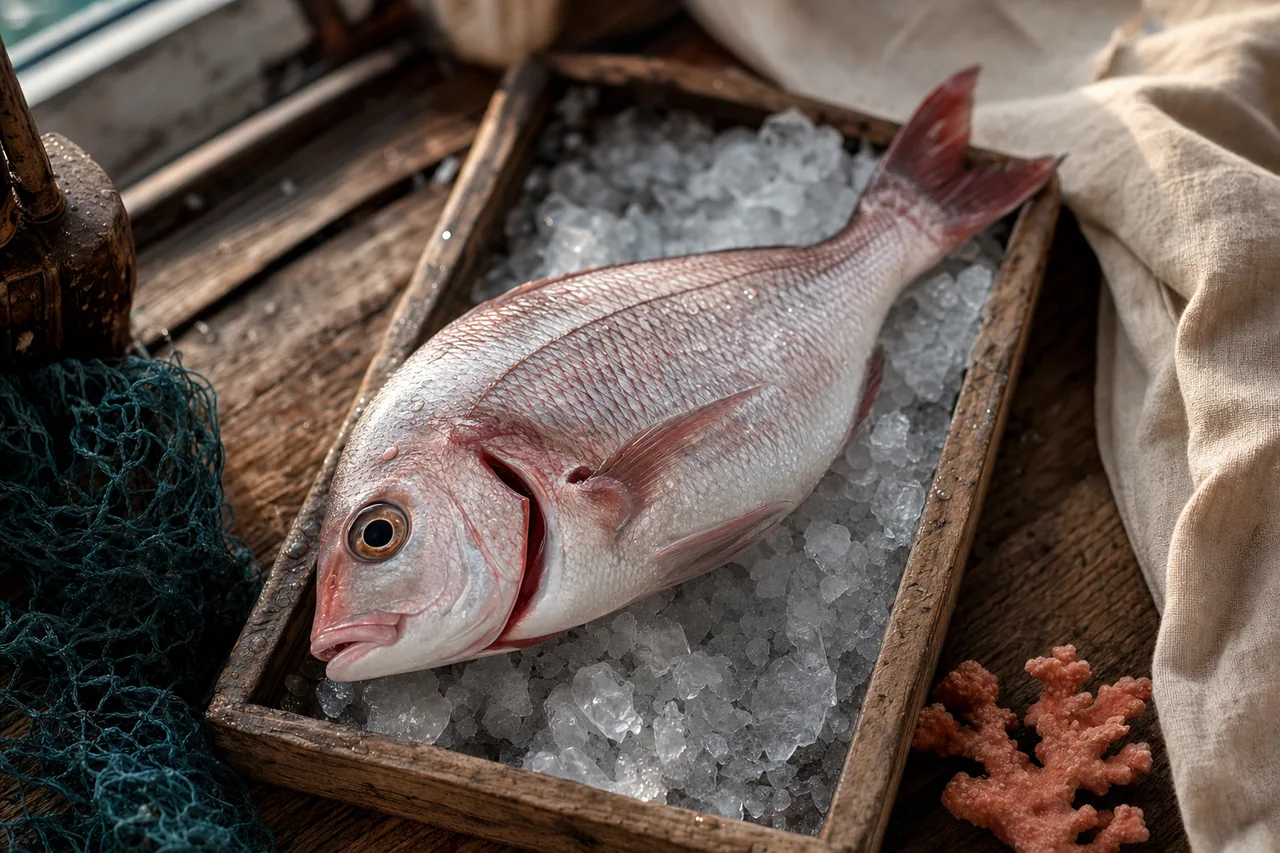
Fresh fish gives itself away through three things you can check in seconds: clear, bulging eyes, deep red gills and a smell of the sea rather than ammonia. If all three are there, the fish is almost certainly from the last twenty-four hours.
Everything else is detail that confirms the first impression. Below we go through each sign in turn, including what to look for in a fillet, where the usual markers are missing, and which Black Sea fish is at its best in which month.
Why freshness decides everything
Fish breaks down faster than meat. The enzymes in its tissue keep working after the catch, and its fats oxidise quickly because they are unsaturated. That is why the difference between fish from yesterday and fish from four days ago is obvious immediately, even when the same cook prepares it the same way.
In fresh fish the flesh is firm and faintly sweet, and the taste of the sea is clean. The more time passes, the more a flavour people describe as "fishy" comes forward, when in truth it is the taste of decomposition that has already begun. Fresh fish forgives mistakes in the cooking, because its quality carries the dish on its own. Stale fish forgives nothing.
The three quick checks
The eyes
Look for a bulging, moist, clear eye with a sharply defined black pupil. In fresh fish the eye sits slightly proud of the head and reflects the light. Over time it starts to sink inwards, the cornea clouds and the pupil turns grey. One qualification: in fish that has sat on ice for a long time the eye can be slightly hazy without the fish being bad. That is why the eye is never read on its own.
The gills
This is the most honest indicator. Lift the gill cover and look underneath. Fresh fish has deep red or bright pink gills, moist and clean, with clearly separated filaments. In ageing fish the colour fades towards brown and grey, a sticky mucus appears and the filaments clump together. The gills give away the age of the fish even when the outside still looks good.
The smell
Fresh sea fish smells of the sea, of seaweed, sometimes faintly of cucumber. It is a clean smell that does not repel. The first hint of ammonia, of sourness, or of anything heavy means the process has started. If you have to hesitate over whether you can smell something, the answer is already clear.
Skin, scales and flesh
The skin of fresh fish shines as though it were still wet, with a natural metallic sheen. The scales sit tight and do not shed when you run a finger along the body. The slime on the surface is clear and thin, not milky and not sticky.
The flesh is tested with light pressure. On fresh fish the dent springs back at once. If a fingerprint stays behind, the fish has been sitting. The whole body should feel firm and springy in the hand. If you take it by the middle and the head and tail droop lifelessly, it is not fish for today. Look at the belly cavity too: in fresh fish it is clean and its walls hold, with no tears and no darkening around the backbone.
And with a fillet, where the markers are missing?
A fillet has no eyes, no gills and none of the smell of a whole fish, so it is judged on other things. Look for a moist, translucent, glossy surface. The fibres should be tightly joined. If the flesh separates into bundles with gaps opening between them, the fillet has been sitting. Yellowing or darkening at the edges, especially on oily fish such as salmon and mackerel, gives away oxidised fat.
Watch the liquid in the packaging or the tray as well. A little clear juice is normal. Cloudy, milky or plentiful liquid means the fish has released its moisture, which happens after long storage or after thawing.
The Black Sea season: which fish when
Freshness also depends on the season, because fish is caught in particular periods and outside them it arrives frozen or from far away. Along our coast the rhythm runs roughly like this:
- Horse mackerel: best from late spring to early autumn, when the flesh is dense;
- Bonito: the classic of early autumn, September and October, when it is at its oiliest and most aromatic;
- Red mullet: summer and early autumn, small but delicate and sweet;
- Turbot: spring is its season, with a clearly defined closed period for fishing;
- Goby and shad: the warm months, staples of Black Sea cooking.
If someone offers you "fresh bonito" in January, that deserves one more question. The season is the first filter, the inspection is the second.
Fresh against ageing: a quick reference
| Sign | Fresh | Ageing |
|---|---|---|
| Eyes | clear, bulging, black pupil | cloudy, sunken, grey |
| Gills | deep red, moist | brown-grey, slimy |
| Smell | sea and seaweed | ammonia, sour |
| Skin | shiny, metallic sheen | dull, dry |
| Scales | tightly attached | shed at a touch |
| Flesh | firm, springs back at once | keeps the fingerprint |
| Body | firm and springy | slack, droops |
How to keep it fresh at home
The journey from the counter to the fridge matters more than it looks. Carry the fish in a cool bag with ice if you are travelling more than twenty minutes or so. At home take it out of the plastic, rinse it in cold water and pat it dry. Put it in a dish over ice, covered, on the coldest shelf, usually the bottom one. If the fish is whole and you are not cooking it straight away, remove the gills and the guts, because they spoil first.
Fresh fish should be cooked within twenty-four hours. If it is going to sit longer, freeze it the same day rather than the next. Thaw it in the fridge overnight, never at room temperature and never in warm water, because the flesh falls apart and loses its juices.
From our kitchen
At Mr. Baba we inspect every delivery on exactly this principle, only every day and in larger quantities. Gills first, then the eye, then a press on the flesh. Whatever fails any of the three does not enter the kitchen.
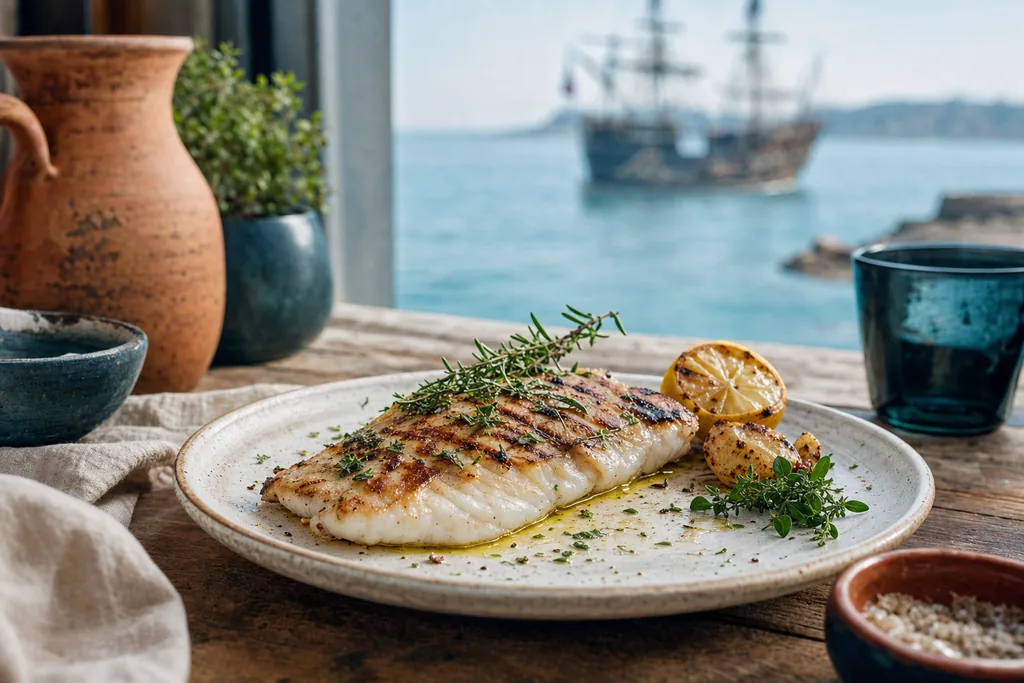
That is why we have a "fish of the day". It is not a marketing phrase but a consequence of how we work. The catch sets the menu, not the other way round. When turbot is in season it is on the board, and when it is not, we do not offer it. A galleon moored beside the Sea Station cannot afford anything else, because our guests are from Varna and they know fish at least as well as we do.
Frequently asked questions
Is it true that fresh fish sinks in water?
Partly. A whole fresh fish usually sinks and a stale one floats, because gases form in its tissue. The test is approximate and depends on the species and its fat content, so treat it as a supplement rather than proof.
Is frozen fish worse than fresh?
Not necessarily. Fish frozen on board within hours of the catch is often in better condition than "fresh" fish that has spent three days in a refrigerated lorry. What matters is that the freezing was quick and that the fish has not been thawed and refrozen.
How do I spot thawed fish at the counter?
Soft, loose flesh gives it away, along with plenty of cloudy liquid in the tray, a sunken eye and scales that fall off easily. If fish is sold as fresh but is lying in a pool of its own liquid, it has most likely been frozen.
Does fresh fish smell at all?
Yes, but of the sea and seaweed, clean and unobtrusive. A complete absence of smell is also a signal, usually of heavy rinsing or processing. A strong "fishy" smell is always a sign that it has been sitting.
Conclusion
Freshness reads in under a minute: eye, gills, smell, then skin and flesh. Add the season as a preliminary filter and mistakes become rare. And when you would rather not check anything at all, have a look at the menu or book a table, and leave the choosing to us.
If the subject interests you, see also squid, octopus and cuttlefish and which Black Sea fish are best when.