
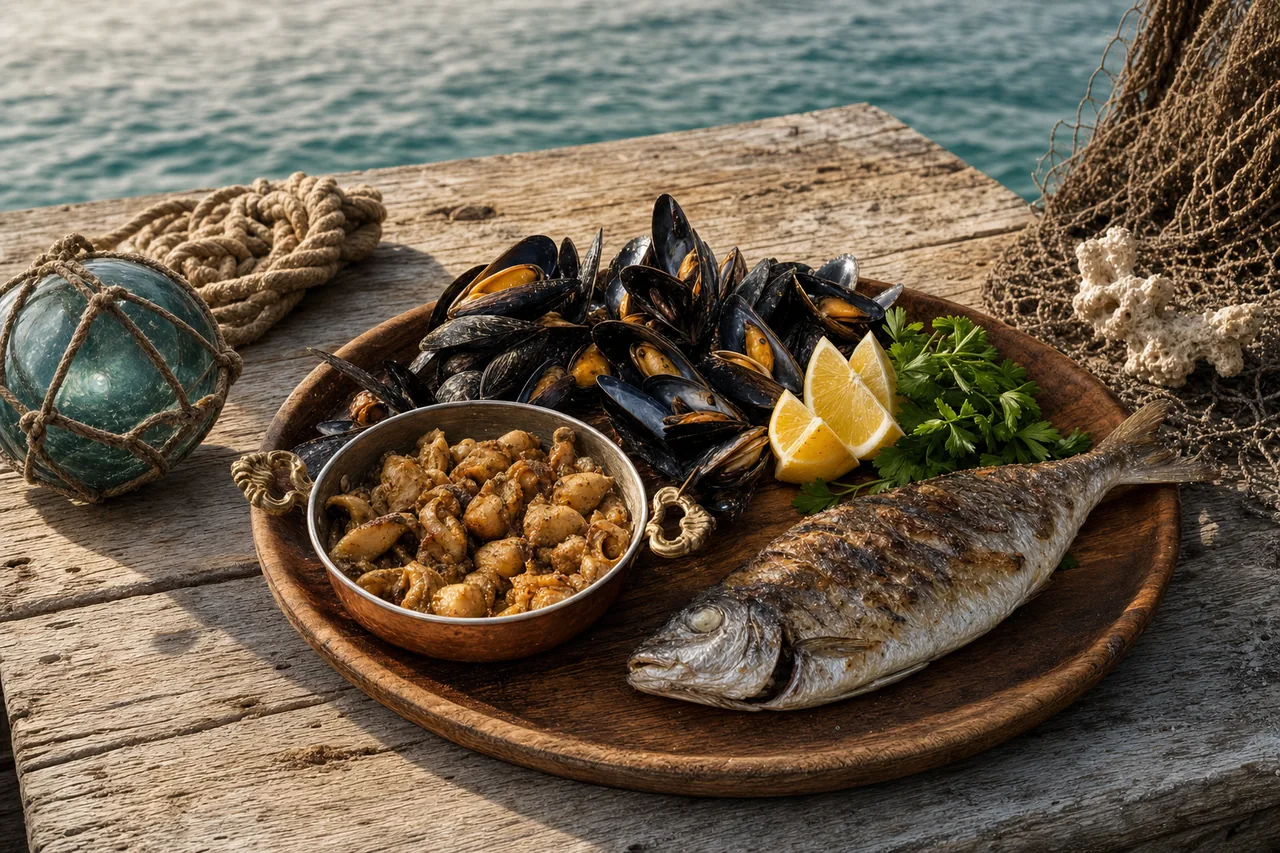
There are six Black Sea delicacies worth ordering in Varna: rapana, bonito, turbot, horse mackerel, black mussels and squid, with taramasalata as the traditional opener. All six are available in August, all cost between 5 and 18 € per portion in a restaurant, and every one of them has a season outside of which it simply is not the same thing. If you eat by the sea once this summer, those six items are the difference between eating fish and eating the Black Sea.
The word delicacy here does not mean expensive. It means local, seasonal, and prepared the way this coast worked out on its own. Some of these things are not in a supermarket at all, and others are so cheap that nobody treats them as a specialty until they taste one fresh. What follows is each of them in turn: when it peaks, how it is served, and what it actually costs on a real menu priced in euro.
What counts as a Black Sea delicacy?
Local, seasonal, and caught here
A Black Sea delicacy is a product that comes out of the Black Sea itself and has a clear season. The list is shorter than most visitors expect, because the Black Sea is poor in species: it is less salty than the Mediterranean and has an oxygen-free layer below roughly 150 metres. That scarcity is exactly what makes the survivors distinctive. Turbot, bonito and horse mackerel are the three fish Varna is known for, while rapana and the black mussel are the two shellfish specialties.
What is on the table but is not local
Half the seafood in a Varna restaurant is not from the Black Sea, and there is nothing wrong with that as long as it is stated plainly. Octopus, tiger prawns and salmon all come from elsewhere. They belong on a Mediterranean menu by right, but they are not a local delicacy. If you specifically want the Black Sea, look for rapana, bonito, horse mackerel, turbot, mussels and taramasalata. Which species surface when is covered in our guide to the fish of the Black Sea.
Why is rapana the signature Black Sea specialty?
An invader that became a delicacy
Rapana is the most distinctive Black Sea delicacy and, at the same time, a foreign species that arrived here by accident. Rapana venosa originates in the Far East and was first recorded in the Black Sea near Novorossiysk around 1947, most likely carried in the ballast water of ships, with the first Bulgarian coastal records dating from 1955. The predatory sea snail proved devastating for native oysters and mussels, but it also handed the region a new catch. Since the 1990s Bulgarian rapana has been harvested by divers, and a large share of the production is exported to Japan and Korea.
How rapana is served
Rapana has dense, almost meat-like flesh that does not tolerate long heat, so it is cooked fast and seasoned assertively. On our menu it appears as rapana kebap, 250 g for 17.99 €, which makes it the most expensive shellfish item on the card and the most requested one in August. If you are trying rapana for the first time, order it to share. The flavour is emphatic enough that a full portion each is rarely what you want.
When is bonito at its best?
August to October is its window
Bonito is at its best from August to October, when the fish carries the most fat and therefore the most flavour. This is the fish the Black Sea coast waits for the way other places wait for a fruit to ripen. In spring the same species is dry and unremarkable. By late summer and autumn the flesh is dense and dark, firm enough to hold up to both salt and fire without falling apart.
The two ways to eat it
Bonito is served two entirely different ways here, and both are worth trying. Lightly salted and raw, with pickled red onion and sumac, 50 g for 5.49 €, it is a cold starter with enough acidity to open a long dinner. As a fillet with rosemary off the hot plate, 220 g for 12.99 €, it becomes a main course. The first shows you the flavour of the fish undisguised, the second shows you what the grill does to it.
| Delicacy | Peak season | How we serve it | Menu price |
|---|---|---|---|
| Rapana | Warm months, June to September | Rapana kebap, 250 g | 17.99 € |
| Bonito | August to October | Lightly salted, 50 g / fillet with rosemary, 220 g | 5.49 € / 12.99 € |
| Turbot | June to March, outside the ban | In garlic olive oil, priced per 100 g | 8.99 € / 100 g |
| Horse mackerel | June to September | Whole, off the hot plate, 250 g | 9.99 € |
| Black mussels | Year round, plumper when cold | With thyme and garlic, or plain, 700 g | 11.99 € |
| Squid | Summer | Hot plate with capers and lemon, 250 g | 13.99 € |
| Taramasalata | Year round | House whipped, with Greek pita, 200 g | 5.50 € |
Is turbot worth it, and why is it sold per 100 grams?
The most expensive fish in the Black Sea
Turbot is the most expensive and most tightly protected Black Sea fish, which is why it is sold by weight rather than by portion. Every specimen is a different size, and the flat body does not cut into standard fillets, so a fixed portion price would be either unfair to the guest or unfair to the kitchen. At 8.99 € per 100 g, a portion of roughly 300 g comes to about 27 €. This is the dish people travel for, and ordering one turbot for two is entirely normal.
Why August has it and May does not
Turbot is under a legal fishing ban from 15 April to 15 June, imposed to protect the species while it spawns. The fish spawns in open water at depths between 25 and 70 metres, peaking in May, and during that window catching it, keeping it on board and selling it are all prohibited. Fresh turbot in May therefore does not exist and should not be offered. By August the ban has long lifted and the fish is back in its regular season.
Which Black Sea delicacy is the most underrated?
Horse mackerel, purely because it is cheap
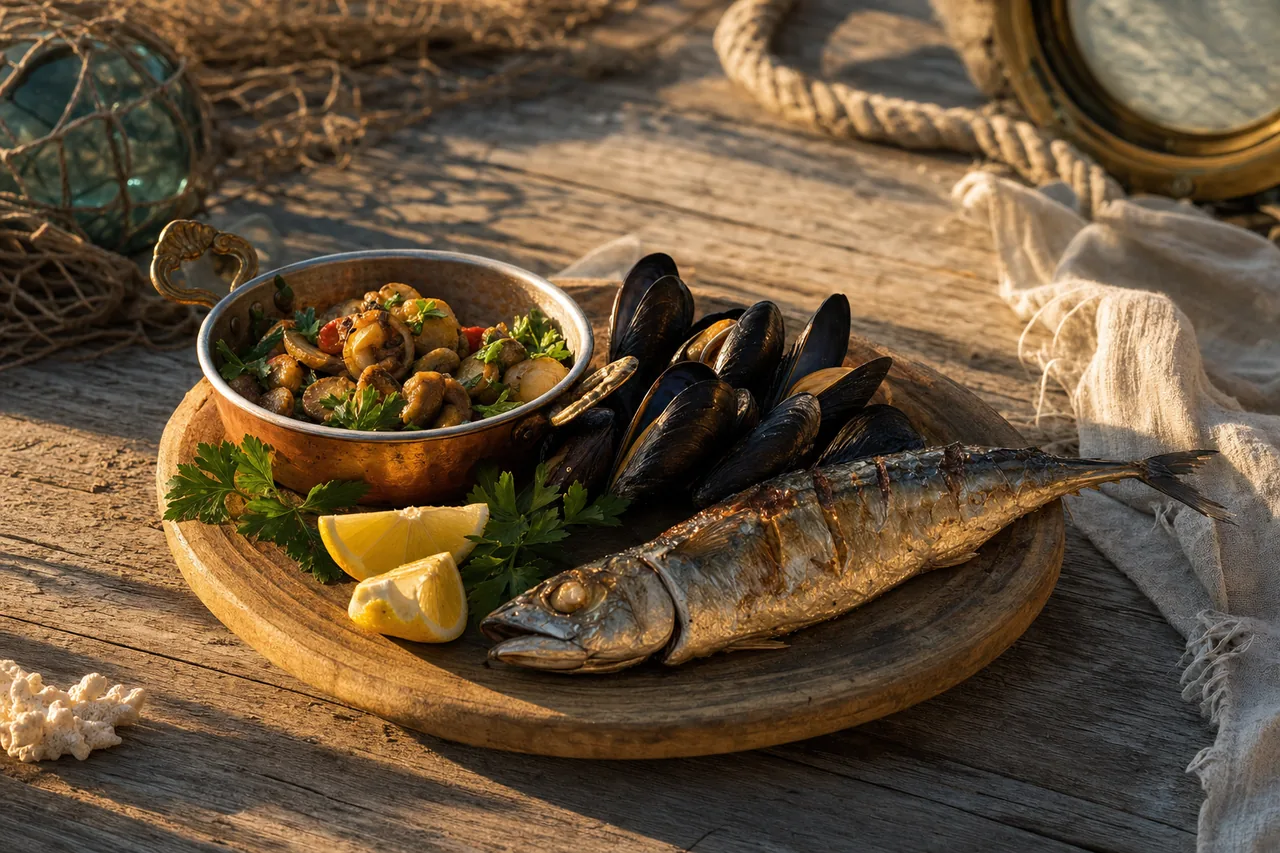
Horse mackerel is the most underrated Black Sea delicacy, and the only reason is its price. It is a small fish, cooked whole with skin and bones, at 9.99 € for 250 g. People walk past it because it is inexpensive and because of the bones, when in fact it delivers the cleanest Black Sea flavour of anything on the list, provided it is genuinely fresh and hits a hot enough surface.
How to judge it and how to eat it
Fresh small fish is recognisable by a clear, slightly bulging eye, bright red gills, and a smell of sea rather than a smell of fish. It is eaten with your hands, with lemon, and without sauce. If you want the full checklist before your next trip to the market, we have written it up in our guide on how to tell fresh fish.
Which shellfish and cephalopods are worth it in August?
The black mussel
The black mussel is the most affordable Black Sea delicacy and works all year, though August demands more care in storage. A portion is 700 g for 11.99 €, steamed with thyme and garlic or served plain, while the spicier version with smoked salmon and tomato is 13.99 €. Mussels cook in four to six minutes, and they are done the moment the shells open wide. Anything that stays shut goes in the bin.
Squid and cephalopods
Squid peaks precisely in summer and is the only cephalopod the Black Sea supplies with any regularity. Off the hot plate with capers and lemon it is 250 g for 13.99 €, or breaded with tzatziki at 10.99 €. Either way the cooking is brief, because slow heat turns squid rubbery, which is the single most common mistake made with it at home.
From our kitchen
The galleon on the seaside promenade has been open since 2005, and August is the month it comes closest to what it was built for: five halls across three levels, around 280 seats, with the Sea Terrace and the Upper Deck open from May to October. More rapana passes through this kitchen in August than in any other month of the year. That is not fashion, it is logistics. Rapana is taken by divers in warm water, which means it is fresh in August and simply is not in January.
One rule has not changed here since the beginning: the fish gives the orders, not the chef. In practice that means the catch of the day is not a printed menu item but a deliberately empty slot that the morning market fills. If the day brings good horse mackerel, it goes on the hot plate whole. If the turbot is good, it goes into garlic olive oil and is weighed per 100 g, because no two turbot are the same size. That is also why the waiter says the catch of the day out loud instead of us printing it.
There is one practical detail guests rarely expect. In August we keep shellfish in smaller batches than in winter, because at this temperature freshness is measured in hours rather than days. Smaller batches mean more frequent deliveries and, occasionally, an item that runs out by eleven at night. That is a deliberate choice in favour of freshness, not poor planning, and we would rather tell you the mussels are gone than serve you yesterday's.
How much does a Black Sea dinner for two cost?
A real bill
A dinner of Black Sea delicacies for two comes to roughly 45 € without drinks if you stay with the local items. For example: taramasalata with Greek pita at 5.50 €, rapana kebap at 17.99 €, horse mackerel at 9.99 € and mussels with thyme and garlic at 11.99 €, everything shared across the table. Add a 300 g turbot and the bill moves to about 72 €, which is still less than most visitors expect for the most protected fish in the sea.
How to order so you taste more
To taste more species, order for the table rather than one main course each. Start with a cold starter, move through the shellfish, and leave the fish for last, because the strongest flavours are better placed late in a long dinner. The full menu with prices in euro is in our summer menu, and what else lands on the plate this month is covered in our piece on the seasonal summer menu.
Frequently asked questions
What is the most distinctive Black Sea delicacy?
Rapana. It is not a native species, having arrived in the Black Sea around 1947, but today it is harvested only here and in neighbouring countries and has become one of the region's main seafood exports.
Is there fresh Black Sea fish in August?
Yes, August is one of the best months of the year. Bonito enters its strongest period, horse mackerel is in season, squid and rapana are at their peak, and the turbot ban lifted back on 15 June.
Are Black Sea delicacies expensive?
Most of them are not. Horse mackerel, mussels and taramasalata run between 5.50 and 12 € per portion. Only two items are genuinely expensive: turbot at 8.99 € per 100 g and rapana at 17.99 € for 250 g.
Do I need a reservation in August?
A reservation is strongly recommended in August, especially for the terrace and for any evening after eight. The Sea Terrace and the Upper Deck operate from May to October and fill up first.
Conclusion
There are six Black Sea delicacies and all six are available in August: rapana, bonito, turbot, horse mackerel, black mussels and squid. Ordered to share, they come to around 45 € for two and tell you far more about this coast than any imported item on the same menu. If you want to try them the way they are meant to be eaten, on a deck above the water, book a table on the galleon and leave the catch of the day to the waiter.